Предмет: Физика, автор: kkiyemov

ДАМ 50 БАЛЛОВ!!!! ПОМОГИТЕ ПОЖАЛУЙСТА

Задание 1

Выбери верное утверждение.

Жидкое вещество в обычных условиях ... .

1) заполняет полностью всё пространство

2) сохраняет форму

3) обладает свойством текучести

Задание 2

Укажи правильный ответ.

 Во время испарения ... .

1) температура воды в стакане понижается

2) температура воды в стакане повышается

3) температура воды в стакане не изменяется

Задание 3

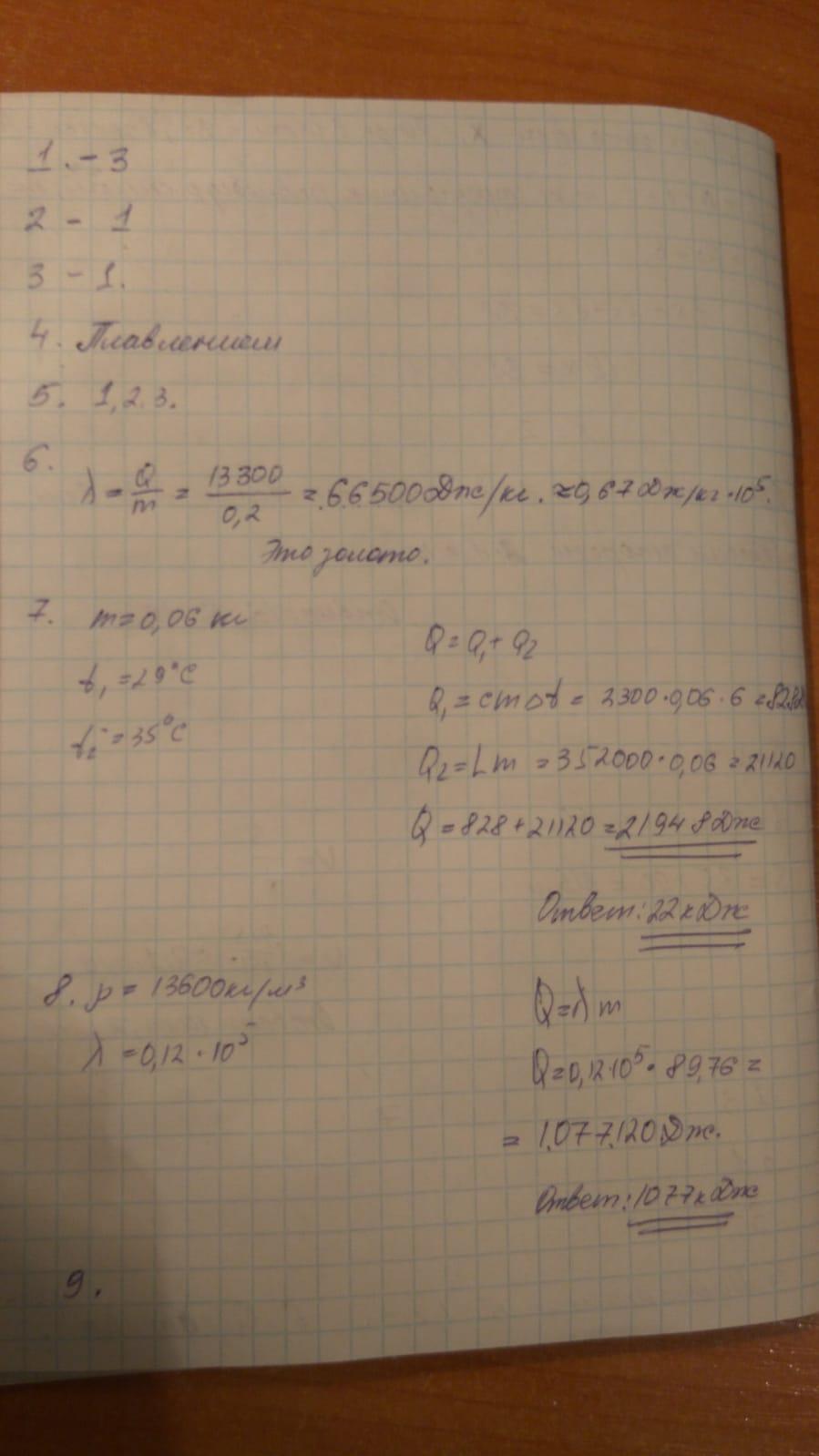
По графику определи, в каком агрегатном состоянии находится медь при температуре 970 °С. (на картинке сверху)

1) В твёрдом агрегатном состоянии

2) В жидком агрегатном состоянии

Задание 4

Заполни пропуск.

Явление превращения твёрдого вещества в жидкое называется  .

(Правильный ответ введи в творительном падеже.)

Задание 5

Выбери, при каких температурах пиджак сможет высохнуть на улице (если правильных вариантов ответа несколько, то отметь все возможные варианты)?

 (Температура указана в °С).

1) −5

2) 6

3) 23

4) Вообще не сможет высохнуть.

Задание 6

Для плавления металла массой 0,2 кг затратили 13,3 кДж тепла. Используя данные таблицы, определи, какой металл расплавили.

Задание 7

Найди, какое количество теплоты нужно для обращения в пар эфира массой 60 г, взятого(-ой) при температуре 29 °С. (Удельная теплоёмкость эфира с=2300 Дж/кг·°С, температура кипения эфира равна 35 ° С, удельная теплота парообразования эфира  L=352000 Дж/кг).

Ответ (округли до целого числа): _____ кДж.

Задание 8

Определи, какое количество теплоты выделится при кристаллизации 6,6 л ртути. Удельная теплота кристаллизации ртути равна 0,12⋅105 Дж/кг, плотность ртути — 13600 кг/м3.

Ответ (округли до десятых): _____ кДж.

Задание 9

Сколько энергии рассеялось при превращении 140 г свинца в жидкое агрегатное состояние, если было израсходовано 14 г бензина, а начальная температура свинца равна 17 °С.

Удельная теплоёмкость свинца — 130 Дж/кг⋅°С, температура плавления свинца равна 327 °С, а удельная теплота плавления свинца — 0,25⋅105 Дж/кг, удельная теплота сгорания бензина — 47⋅10^6 Дж/кг.

Ответ (округли до десятых):  _____кДж.

Задание 10

В сосуде, теплоёмкость которого равна 190 Дж/°С, находится 2 л воды и 0,7 кг льда при 0°С. Чтобы получить воду с температурой 8 °С, в сосуд впускают водяной пар при 100 °С. Найди массу пара.

(Удельная теплоёмкость воды с=4200Дж/кг⋅° С, удельная теплота парообразования L =2260000 Дж/кг, удельная теплота плавления льда λ=330000 Дж/кг).

Ответ (округли до целого числа): _______ г.

Ответы

Автор ответа: nuchtosh1
1

Ответ:

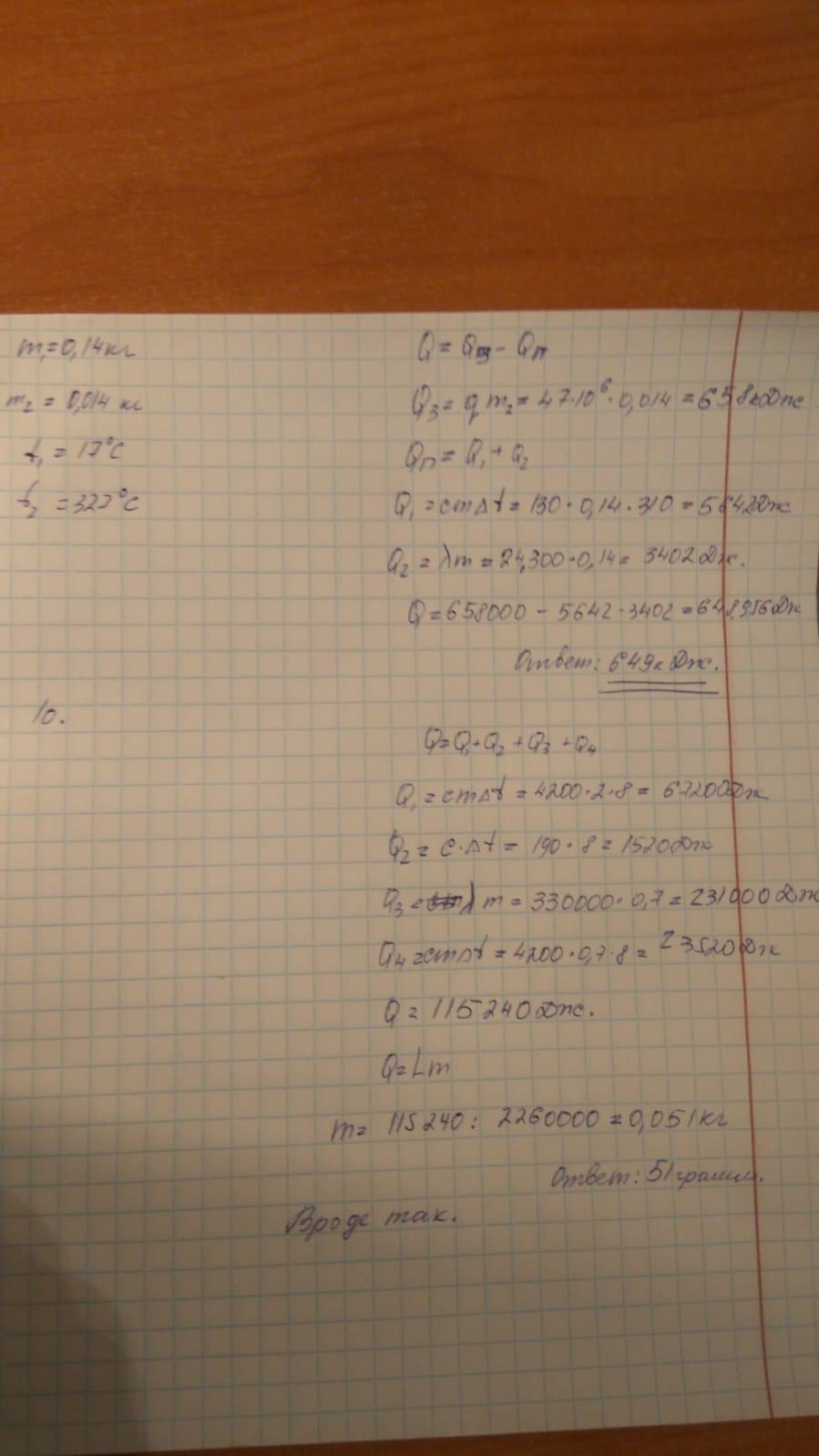
все в прикрепленных

Объяснение:

все в прикрепленных

если что прости

Приложения:
kkiyemov: в 10- 122
nuchtosh1: что поставили?
nuchtosh1: если учитель проверял, то в 9 можешь поспорить, т.к. 648,956 не округляется до десятых
kkiyemov: привет
kkiyemov: можешь пожалуйста помочь с ещё одним тестом
kkiyemov: я за него дам 50 баллов
kkiyemov: он в моих вопросах в моем аке
kkiyemov: помоги пж
nuchtosh1: не нашел, какой вопрос?
kkiyemov: сейчас я его заново задам его просто удалили
Похожие вопросы
Предмет: Английский язык, автор: Dirtynick
перевести

Criminal Law
Criminal law is categorized as a part of public law — the law regulating the relations between citizens and the state. Crimes can be thought of as acts which the state considers to be wrong and which can be punished by the state.
In many legal systems it is an important principle that a person cannot be considered guilty of a crime until the state proves he committed it. The suspect himself need not prove anything, although he will of course help himself if he can show evidence of his innocence. The state must prove his guilt according to high standards, and for each crime there are precise ele-ments which must be proven. In codified systems, these elements are usu-ally recorded in statutes. In common law systems, the elements of some crimes are detailed in statutes; others, known as "common law crimes", are still described mostly in case law. Even where there is a precise statute, the case law interpreting the statute may be very important since the circum-stances of each crime may be very different.
For example, the crime of theft is defined in England under the 1968 Theft Act as: "dishonestly appropriating property belonging to another with the intention of permanently depriving the other of it".
There are further definitions of each element of the definition, such as appropriating, which may mean taking away, destroying, treating as your own, and selling. The same Act also defines in detail crimes such as bur-glary (entering someone's land without permission intending to steal or commit an act of violence) and robbery (using force or threats in order to steal from someone). Although the Theft Act was intended to cover many possible circumstances, it is still often necessary for the courts to refer to case law in order to apply the Act to a new case. For example, in the 1985 case of R.vs.Brown, the defendant argued he couldn't be guilty of burglary since he reached through the window of a house without actually going in-side. However, the court decided a person can be judged to have "entered" a building if he gets close enough to be able to remove something from it.
There are usually two important elements to a crime: (I) the criminal act itself: and (II) the criminal state of mind of the person when he committed the act. In Anglo-American law these are known by the Latin terms of (I) Actus Reus and (II) Mens Rea. The differences between these can be explained by using the crime of murder as an example.
In English law there is a rather long common law definition of murder- The unlawful killing of a human being under the Queen's Peace, with mal-ice aforethought, so that the victim dies within a year and a day.
Malice aforethought refers to the mens rea of the crime and is a way of saying that the murderer intended to commit a crime. Of course, the court can never know exactly what was in the head of the killer at the time of the killing, so it has the difficult task of deciding what his intentions must have been. The judgments in many recent cases show that English law is con-stantly developing its definition of intent.