Предмет: Биология, автор: 12345jule

. В процессе энергетического обмена произошло расщепление 7 молекул глюкозы, из которых полному расщеплению подверглись 2 молекулы.

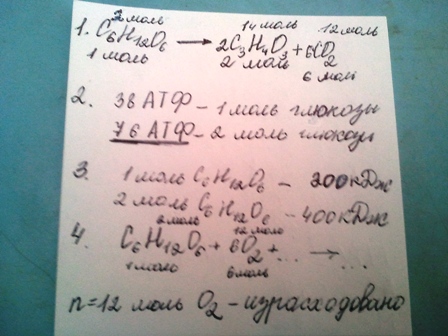
Определить:1. Сколько молекул ПВК и СО2  при этом образовалось? 2. Сколько синтезировалось молекул АТФ? 3. Сколько энергии аккумулировалось в этих АТФ? 4. Сколько израсходовано молекул кислорода?

Ответы

Автор ответа: анька19
0


1) образовано 14 моль ПВК и 12 моль СО2 
2) синтезировано 38х2 + 2х5=76+10=86 моль АТФ
3) на расщЕпление израсходовано 12 моль кислорода

Автор ответа: Аэроплан
0

По условию задачи нам дано 7 моль глюкозы ,но полному расщеплению подверглось 2 моль глюкозы,значит и расчёты по задаче мы будем вести исходя из 2 моль глюкозы .

Дальнейшее решение задачи написано во вложении,если непонятно то пиши мне ,объясню.

Приложения:
Похожие вопросы
Предмет: Английский язык, автор: alken12
Помогите с переводом с английского на русский
Astronomers spot the biggest, strangest black hole collision ever found
The cosmic pile-up produced the first black hole of its kind ever detected—and that’s not the weird part.
More than seven billion years ago, two immense black holes circled each other until they collided and merged, a cataclysm so intense that it sent ripples soaring through the fabric of space-time. In the early morning hours of May 21, 2019, Earth trembled from the vibrations sent off by this distant carnage, cluing in astronomers to the biggest cosmic bang they’d ever detected—and one that defies theoretical expectation.The signal picked up by two observatories—LIGO in the United States and Virgo in Italy— came in the form of gravitational waves: disruptions in space-time that massive cosmic events can set into motion.
This signal—named GW190521—came from a truly monstrous collision. Researchers estimate that two black holes 66 and 85 times more massive than our sun spiraled into each other, uniting to form a black hole 142 times more massive than our sun.The event, announced today in Physical Review Letters, is by far the biggest ever detected via gravitational waves. In a fraction of a second, the merging black holes released roughly eight times more energy than that contained within our sun’s atoms, all in the form of gravitational waves. That amount of energy is like setting off more than a million billion atomic bombs every second for 13.8 billion years, the age of the observable universe.
Caltech astronomer Matthew Graham, who isn’t part of the LIGO or Virgo teams, calls the event “probably the largest explosion we’ve ever known in the universe.”
The black hole merger is causing a lot of scientific excitement, for a few reasons. First, the black hole it produced fills in a perplexing gap in our observations. Until now, researchers had found black holes tens of times more massive than our sun and supermassive black holes millions to billions times more massive than our sun, but never had confirmed one between 100 and 100,000 solar masses. Clocking in at about 142 solar masses, GW190521’s final black hole is the first ever found in this intermediate range.