Предмет: Русский язык, автор: muzza2003

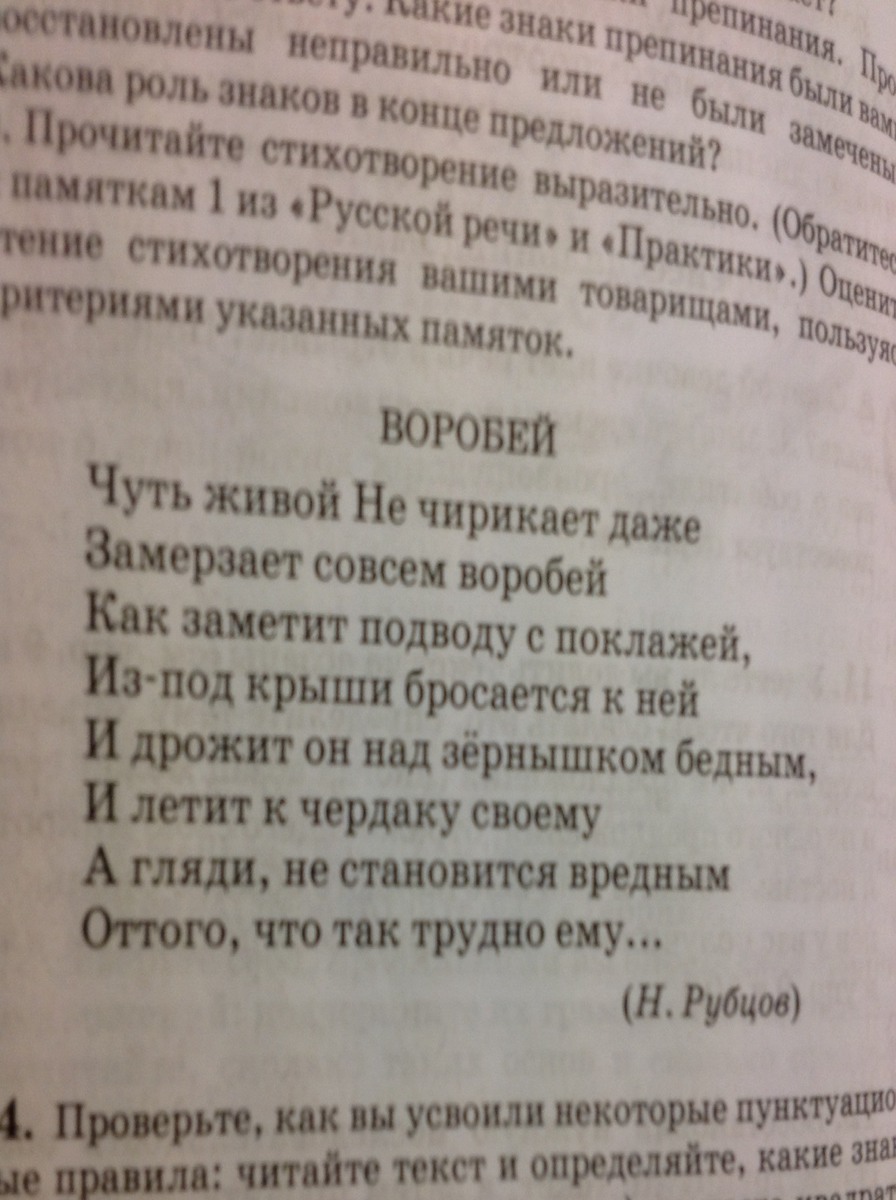
Нужно расставить знаки припенания...

Приложения:
Ответы

Автор ответа: Kate30122001
0
1. ,
2,
3,,,.,,,,,
5,.ю.Ю,,,,
Автор ответа: Nastyxa1309
0
Чуть живой,Не чирикает даже.
Замерзает совсем воробей.
Как заметит подводу с поклажей,
Из-под крыши бросается к ней.
И дрожит он над зёрнышком бедным,
И летит к чердаку своему,
А гляди,не становится вредным.
Оттого,что так трудно ему...
Похожие вопросы
Предмет: Английский язык, автор: Kaau
Task 4 Fill the gaps in the text with words from the box below. There are more words than you need. Write your answers on your answer sheet. Petrol litter pollution traffic jams cardboard rainforests floods plants public transport coal global warming packaging wildlife electricity waste droughts recycle oil the countryside weather A Planet in Trouble There are more problems facing the environment today than at any time in the past. World population stands at around 6 billion and by the end of the 21st century, it may reach 8 or 10 billion. To satisfy the needs of these people, we are destroying ………16…….. and other natural places so that we can grow food and put up buildings. This creates ……17………… of the land, sea and air, which can be very bad for the health of humans and ……18………….such as birds or animals. Most scientists now agree that it has also caused ……19………… and this means that the temperature of the Earth is rising. The ice of the North Pole could melt, raising sea levels and causing serious ……20………. . Generally, the Earth’s ……21………….. will be worse and there will be more wind, rain and ……22……. . However, there are things we can do. Scientists are working to come up with ways of making power that do not cause so much pollution. People at home can recycle their ………23………, paper and glass and try to use less ……24………… by turning off lights, TVs and stereos when they are not using them. We could all use our cars less and walk or use ………25………….. more.
Предмет: Русский язык, автор: 12320071
Предмет: Английский язык, автор: MilkyWayyy15
Переведите пожалуйста, только не через переводчик.

Desalinization
Desalinisation has the potential to provide an adequate water quantity to those regions that are freshwater poor, including small island states. However, the energy demands of reverse osmosis, a widely-used procedure used to remove salt from water, are a challenge to the adaptation of this technology as a sustainable one. The costs of desalination average around 0.81 USD per cubic meter compared to roughly 0.16 USD per cubic meter from other supply sources (USGS, 2010). If desalination can be provided with renewable energies and efficient technologies, the sustainable features of this supply source would increase. Currently, desalinationincreases operational costs because of the needed energy (and also carbon dioxide emissions); this in turn raises the cost of the final product. In addition, desalination plants can have negative impacts on marine life, and cause water pollution due to the chemicals used to treat water and the discharge of brine.

Bottled Water
Bottled water is a 21st century phenomenon whereby mostly private companies provide potable water in a bottle for a cost. In some areas, bottled water is the only reliable source of safe drinking water. However, often in these same locations, the cost is prohibitively expensive for the local population to use in a sustainable manner. Bottled water is not considered an “improved drinking water source” when it is the only potable source available (UN, 2010). When sustainability metrics are used to access bottled water, it falls short in many situations of being a sustainable water supply. Economic costs, pollution associated with its manufacturing (plastic, energy, etc.) and transportation, as well as extra water use, makes bottled water an unsustainable water supply system for many regions and for many brands. It takes 3-4 liters of water to make less than 1 liter of bottled water (Pacific Institute, 2008).

Potable Water
Potable water requires some of the strictest standards of quality in terms of bacteriological and chemical pollutants. These standards are often governed by national governments; international recommendations can be found from the World Health Organization. Drinking water must be freshwater and should be free of pathogens and free of harmful chemicals.
Предмет: Русский язык, автор: khachatryanmariana