Предмет: Алгебра, автор: fctdgsygfdhngfxzgsac

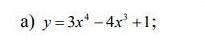
Дослідити функцію методами диференціального числення та побудувати її графік.
Приложения:

Ответы

Автор ответа: natalyabryukhova
2

Ответ:

График построен.

Объяснение:

Исследовать функцию и построить график.

у = 3х⁴ - 4х³ + 1

1. Область определения функции:

х ∈ R

2. Четность, нечетность.

  • Если f(-x) = f(x), то функция четная, если f(-x) = -f(x) - нечетная.

f(-x) = 3 · (-x)⁴ - 4 · (-x)³ + 1 = 3x⁴ + 4x³ + 1

f(-x) ≠ f(x) ≠ -f(x)

функция не является четной или нечетной.

3. Функция непрерывна. Асимптот нет.

4. Возрастание, убывание. Точки экстремума.

Найдем производную, приравняем к нулю и найдем корни.

у' = 3 · 4x³ - 4 · 3x² = 12x³ - 12x² = 12x²(x - 1)

12x²(x - 1) = 0

x = 0;     x = 1

Отметим их на числовой оси и определим знаки производной на промежутках.

---[0]---[1]+++

  • Если "+" - функция возрастает, если "-" - функция убывает.

функция убывает на промежутках (-∞; 0],   [0; 1];

функция возрастает на промежутке [1; +∞)

  • Если производная меняет знак с плюса на минус, то в данной точке наблюдается максимум, если с минуса на плюс, то в данной точке  - минимум.

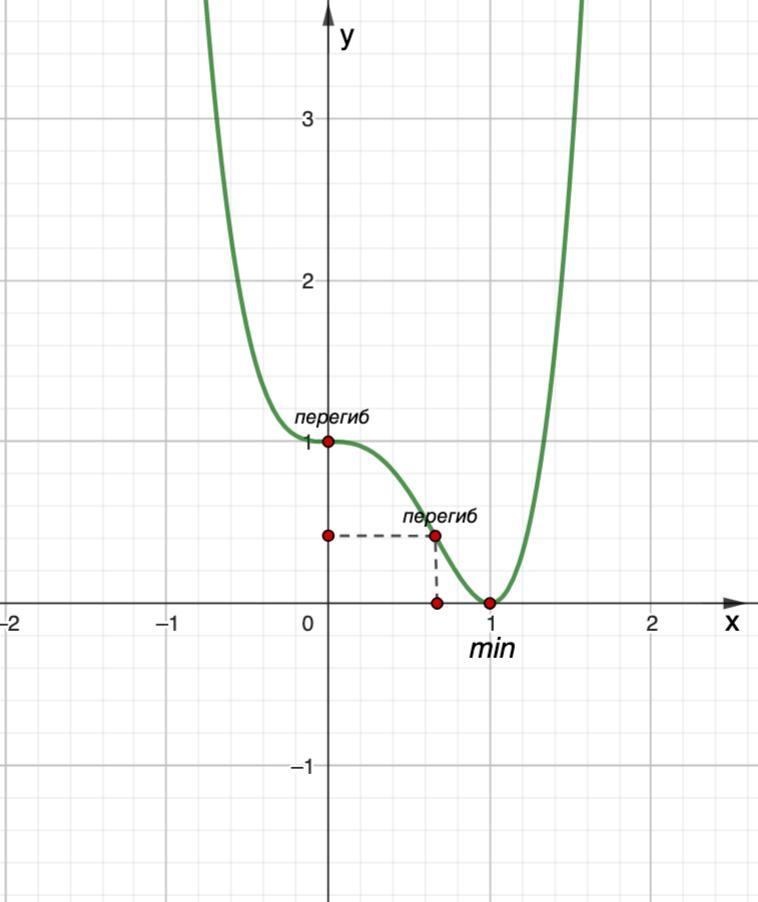
x min = 1

y(1) = 0

5. Выпуклость, вогнутость. Точки перегиба.

Найдем производную второго порядка, приравняем к нулю и найдем корни.

y'' = 12 · 3x² - 12 · 2x = 36x² - 24x = 12x (3x - 2)

12x (3x - 2) = 0

x = 0;     x = 2/3

Определим знаки производной на промежутках.

+++[0]---[2/3]+++

  • Если производная второго порядка положительна, функция вогнута, если отрицательна - выпукла.

функция вогнута на промежутках (-∞; 0];  [2/3; +∞);

функция выпукла на промежутке [0; 2/3]

  • Точки, в которых вторая производная меняет знак - точки перегиба.

х перегиба = {1; 2/3}

y(1) = 0;     y(2/3) = 11/27.

Строим график.
Приложения:

fctdgsygfdhngfxzgsac: спасибо вам большое)))
Похожие вопросы
Предмет: Английский язык, автор: rostikra2010
СРОЧНО ПОМОГИТЕ
прочитайте текст и зделайте задания в низу

The sailor and the monkeys
A ship stopped at the coast of South Africa. One of the sailors left the ship and went to a town near the coast. He had some blue caps made of wool in a bag and wanted to sell them in the town. The sun was hot and the sailor decided to have a rest in the forest. He sat down under a big tree, took one of the caps out of his bag and put it on his head. He slept for some time. When the man woke up, he took his cap off and wanted to put it into his bag with the other caps. But he saw that there were no caps in it now. Where were they? "Where are my caps?" he cried. Then the sailor heard a great noise in the trees above his head. He looked up and saw monkeys, and each monkey had a blue cap on its head! "Give me back my caps, you monkeys!" he cried. But the monkeys didn't listen to him. They only jumped from tree to tree and made a great noise. "Give me back my caps!" he cried again and again. But nothing helped. The monkeys only looked at him. Then the sailor was very angry. He took off the blue cap, threw it on the ground and cried, "You have taken all my caps! You can have this cap too!" The monkeys saw him do that. Then each monkey took off the cap and threw it on the ground. The sailor picked up his caps, put them into his bag and went to town.

1. Listen to the text. Are the following statements about the text true or false? Change the false statements to make them true.
1. A ship stopped at the coast of North Africa.
2. One of the sailors went to a village near the coast.
3. He had some blue caps made of wool in a bag.
4. The sailor decided to have a rest in the hotel.
5. He put one cap on his head and went to bed.
6. When he woke up, he couldn't find his caps.
7. The sailor heard a great noise in the trees above his head.
8. He saw monkeys with blue caps on their heads.
9. The monkeys were funny in the caps and the sailor was happy.