Предмет: Математика, автор: mirkaaaar

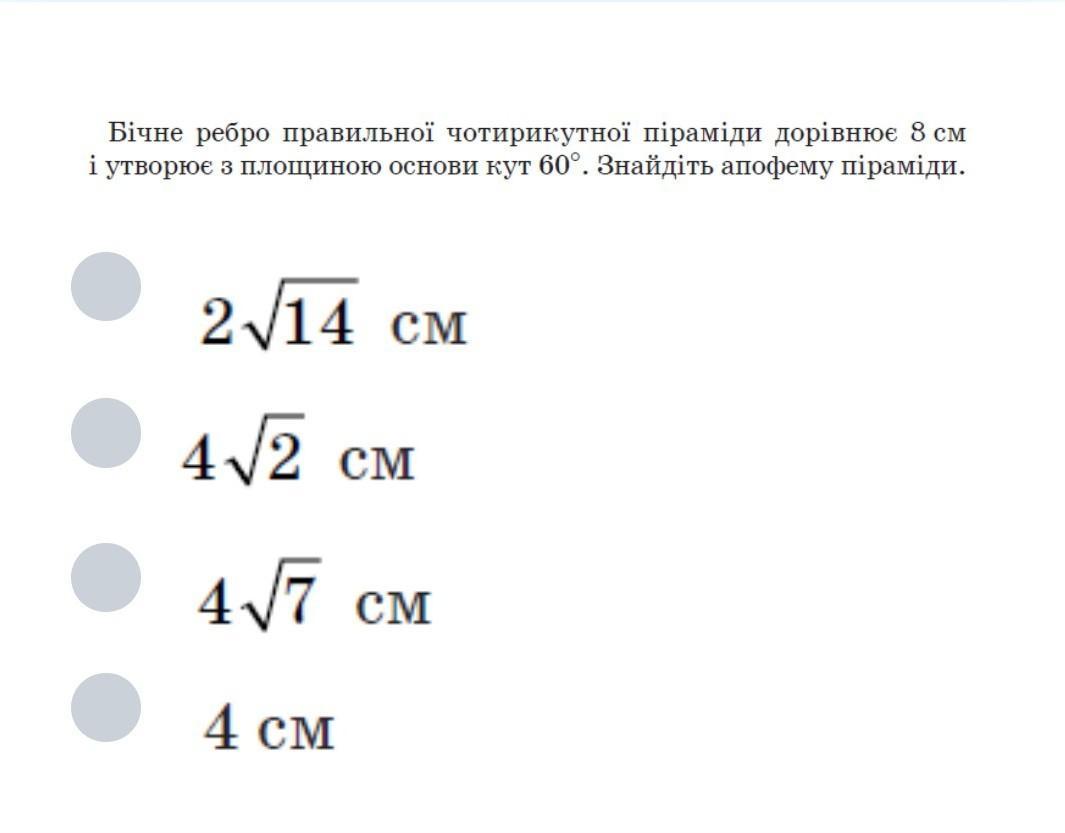
Віддам 50 балів(лише відповідь) бічне ребро правильної чотирикутної піраміди дорівнює 8см і утворює з площиною основи кут 60(градусів). Знайдіть апофему піраміди(варіанти відповідей на фотографії)​

Приложения:

pomogut1: Таким образом, длина боковых граней пирамиды равна 4.62 см, а боковое ребро равно 8 см.

Ответы

Автор ответа: muzikav70482
0

Ответ:

Для розв'язання цієї задачі нам знадобиться формула для обчислення апофеми правильної чотирикутної піраміди:

a = √(h^2 + (b/2)^2)

де a - апофема, h - висота піраміди, b - довжина бічного ребра.

Дано, що b = 8 см, а кут між бічним ребром і площиною основи дорівнює 60 градусів. Це означає, що утворений трикутник є рівнобедреним, а довжина однієї з його бічних сторін дорівнює:

c = b * sin(60°) = 8 * √3 / 2 = 4√3 см

Залишилося знайти висоту h. Для цього візьмемо інший трикутник, утворений висотою і половиною бічного ребра, та застосуємо теорему Піфагора:

h^2 = (b/2)^2 - c^2 = 8^2 / 4 - (4√3)^2 = 16 - 48 = -32

Отримали від'ємне значення для квадрату висоти. Це означає, що така піраміда не існує, оскільки висота повинна бути додатнім числом.

Отже, відповідь: такої піраміди не існує.

Пошаговое объяснение:


mirkaaaar: добрий вечір.Такого не може бути.Відповідь повинна бути серед цих запропонованих варіантів
muzikav70482: У тебе браковане завдання
mirkaaaar: :(
muzikav70482: Скажи потім вчительці, що завдання не правильне і покажи відповідь мою, але бажано зрозумій завдання
new291481: У тебе не правильно вирiшино
mirkaaaar: дякую,так й зроблю
new291481: Этот ответ не правильный у меня правильно все я все розьяснил
Автор ответа: new291481
0

Ответ:

Апофема правильної чотирикутної піраміди - це відрізок, який проведений від середини бічної грани до центра основи піраміди, тобто він є радіусом вписаного кола в основу піраміди.

Для знаходження апофеми піраміди, нам потрібно використовувати формулу, що пов'язує апофему з бічним ребром та кутом між апофемою та бічним ребром:

апофема = бічне ребро / (2 * tg(кут між бічним ребром та апофемою))

У нашому випадку, ми знаємо, що бічне ребро дорівнює 8 см, а кут між бічним ребром та площиною основи дорівнює 60 градусів. Тому:

апофема = 8 см / (2 * tg(60 градусів)) ≈ 4.62 см

Таким чином, апофема цієї піраміди дорівнює близько 4.62 см.

Пошаговое объяснение:


new291481: Это правильный ответ варианты реально ошибочные я незнаю что там такое если то пиши 4.7 но ответ 4.62
muzikav70482: норм чат джпт
new291481: нет
Похожие вопросы
Предмет: Английский язык, автор: dosimetova2511
Mark Turner Language: Journal of the Linguistic Society of America. Review of Talmy, Leonard. Toward a Cognitive Semantics. Volume 1: Concept Structuring Systems. Volume 2: Typology and Process in Concept Structuring. Cambridge: MIT Press, 2000. In the two volumes of this widely-anticipated work, Leonard Talmy systematically arrays and expands the studies that have won him immense influence as one of the most original theorists of language. Here are refined versions of classic articles such as "The Relation of Grammar to Cognition," "Fictive Motion," "How Language Structures Space," "The Windowing of Attention in Language," "Figure and Ground," "Force Dynamics in Language and Cognition," "The Semantics of Causation," "Lexicalization Patterns," "The Cognitive Culture System," and "A Cognitive Framework for Narrative Structure." "Semantics," Talmy observes, "is intrinsically cognitive." Grammars reveal conceptual structures, expressions prompt for conceptual arrays, and linguistics is a method for discovering the way we think. Talmy takes the view, familiar from various traditions of philology and linguistics, that language conforms to a fundamental design feature: it is divided into two subsystems, the grammatical and the lexical. The lexical subsystem consists of the "open" classes of linguistic forms, including ideophonic, adjectival, verbal, and nominal roots. In contrast, the grammatical subsystem consists of all other forms, that is, "closed" classes, and accordingly includes grammatical categories and subcategories, grammatical relations, word order patterns, and grammatical complexes such as constructions, syntactic structures, and complement structures. Sentences prompt listeners to construct cognitive representations. The lexical subsystem, for the most part, provides cues for their content, while the grammatical subsystem, for the most part, provides cues for their structure. Our capacity for language depends on our ability to integrate disparate conceptual contents and conceptual structures to create unified cognitive representations, and equally on our ability to use a relatively limited inventory of grammatical and lexical forms to prompt for virtually unlimited ranges of cognitive representations. Crucially, there is an elaborate semantics of grammar, that is, a closed-class semantics, informed by a system of constraints having to do with topology, perspective, attention, viewpoint, figure and ground, time and space, location and motion, and force and causation. Talmy analyzes the semantics of grammatical and lexical subsystems and the ways in which they interact. The grammatical subsystem, for example, provides topological rather than Euclidean cues: English deictics this and that, the English preposition across, and the English past tense inflection -ed are all closed-class items that are neutral with respect to magnitude of space or time, allowing us to say with equal felicity, "This ant crawled across my palm" or "This bus drove across the country." These grammatical forms prompt for topological structure, for mental "rubber-sheet geometry" that can be stretched indefinitely without challenging semantic constraints. review​