Предмет: География, автор: lera0019

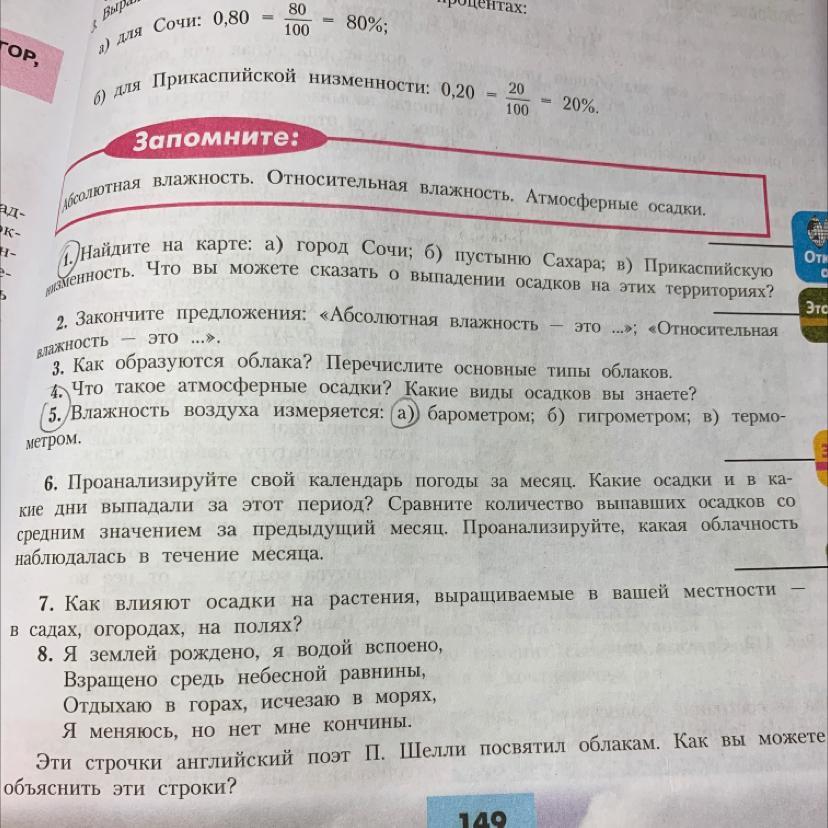
Помогите с 3,4,5,7 вопросами,заранее спасибо))
Приложения:

Ответы

Автор ответа: sweta7612
0

Ответ:

3.Вот как образуются облака: теплый воздух с водяными парами поднимается в небо. На определенной высоте теплый воздух охлаждается.

При низких температурах влага не может больше находиться в виде водяных паров. Лишняя влага превращается в капельки воды, частички льда — вот так образуется облако.

Нет двух похожих облаков, они постоянно меняют свою форму. Различие формы облаков объясняется тем, что они образуются на различной высоте и при различной температуре. Кроме того, облака могут состоять из различных частичек, в зависимости от высоты и температуры.

Самые высокие облака называются «светящиеся» .

Они находятся на высоте 50-100 км! Затем идут «перламутровые» . Они располагаются на высотах от 22 до 33 км. Это очень тонкие, красиво раскрашенные облака, состоящие из пыли или дождевых капелек. Их можно наблюдать только после захода Солнца или перед восходом.

На высоте 10 км и выше располагаются «перистые» , «перисто-слоистые» и «перисто-кучевые» облака. Перистые облака похожи на перья и волокна, перисто-слоистые — на тонкие беловатые полосы, перисто-кучевые — это небольшие округлые облака, о них мы говорим «небо в барашках» .

Все эти облака состоят из тонких льдинок.

Низкие облака состоят из маленьких капелек воды. На высоте 3-5 км от поверхности Земли располагаются высококучевые облака, состоящие из больших масс паров и частиц, чем перисто-кучевые облака. На такой же высоте образуются высокослоистые облака, часто закрывающие все небо серой вуалью, сквозь которую Солнце и Луна просвечивают бледными пятнами.

Ниже, на высоте двух километров, формируются слоисто-кучевые облака — крупные и комковатые. На этой же высоте располагаются дождевые облака — плотные, темные, бесформенные. На высоте менее 610 метров находятся слоистые облака — поднявшийся вверх туман.

Кучево-дождевые облака — высокие, плотные, похожие на цветную капусту облака, приносящие грозы и сильные ветры

4. Атмосфе́рные оса́дки (также — гидрометео́ры) — атмосферные явления, связанные с присутствием в атмосфере воды в жидком или твёрдом состоянии, выпадающей из облаков или осаждающейся из воздуха на земную поверхность и какие-либо предметы

Виды осадков : дождь. морось , град, снег

5. б) гидрометром

7. Ну тут уж по своей местности.

Вообще то такие осадки как дождь, питают почву влагой, помогают расти растениям.

Град приносит иногда вред, если крупный может побить растения.

Объяснение:

Похожие вопросы
Предмет: Английский язык, автор: nina09062010
 

Read the text and choose the correct option: True - if the statement is correct, False - if the information is incorrect, Not stated - if the text does not contain enough information to choose either a positive or negative answer.

... We represent the Young Journalists' Club and we are looking to collaborate with organizations and individuals who are interested in publishing, promoting or displaying our articles and materials. Though most of the members of the club are amateur journalists, we do the job very professionally and you can see our articles not only on internet blogs but in reputed journals as well (the list is below). We research teenagers' lives in order to understand what today's youth are interested in, what they care for, and what, on the contrary, they are indifferent to. We carry out surveys and questionnaires, analyse related statistics which make our conclusions reliable and focused. The articles we prepare comprise politics and culture, environmental issues and human rights problems; they may be controversial as we try to display the diversity of views and opinions. If you think you may find our articles of some interest, we would be happy to discuss any form of collaboration.

Just to give you some idea of the materials we have, we'll share some of our recent findings:

Lately we've been looking into the issue of TV, i.e. what teenagers watch on TV and what TV programmes they enjoy. Forty teenagers, aged 14 - 16, were interviewed, and we received some curious results. Here are some of them:

About thirty-five percent of the interviewed said that they don't watch the news at all. Our respondent Julia Smith commented on it like this: "I don't watch the news. They talk about either wars or terrorist attacks. If I watch it, I start feeling down and scared... so... I just don't watch."

Sixty-five percent watch the news occasionally and randomly. People from that group were unable to name any programme they trust. They confuse Presidents and Prime Ministers, they are not sure about the regions of armed conflicts and they do not know what the word summit means. However, more than half of our respondents noted that they would like to feel more confident about political issues and that it would be useful to have some Political Literacy classes in the school curriculum.

The survey also revealed some really unexpected things. For example, most teenagers are not actually keen on thrillers and action films. They say they definitely prefer point-and-shoot computer games to action films.

As for TV, about sixty percent of our respondents claim that they would like to have more educational and popular science films and programmes on TV. Scientific breakthroughs, cutting edge technologies, the mysteries of the ancient civilizations - all these topics would be very welcome...


A7   The members of the Club write their articles only for internet resources.

1) True     2) False      3) Not stated

A8   To become a member of the Club the candidate has to present some pieces of writing.

1) True     2) False      3) Not stated

A9   The members of the Club focus on writing about teenage life and related issues.

1) True     2) False      3) Not stated

A10  The members of the Club work on a volunteer basis.

1) True     2) False      3) Not stated

A11   The research proves that teenagers are poorly educated about political issues.

1) True     2) False      3) Not stated

A12  The research proves that all teenagers consider talking about politics a waste of time.

1) True     2) False      3) Not stated

A13  The members of the Club never give away the names of their respondents.

1) True     2) False      3) Not stated

A14  The results of the research provide some ideas on how to make TV more interesting for teenagers.

1) True     2) False      3) Not stated