Предмет: Математика, автор: sultanovakarina58

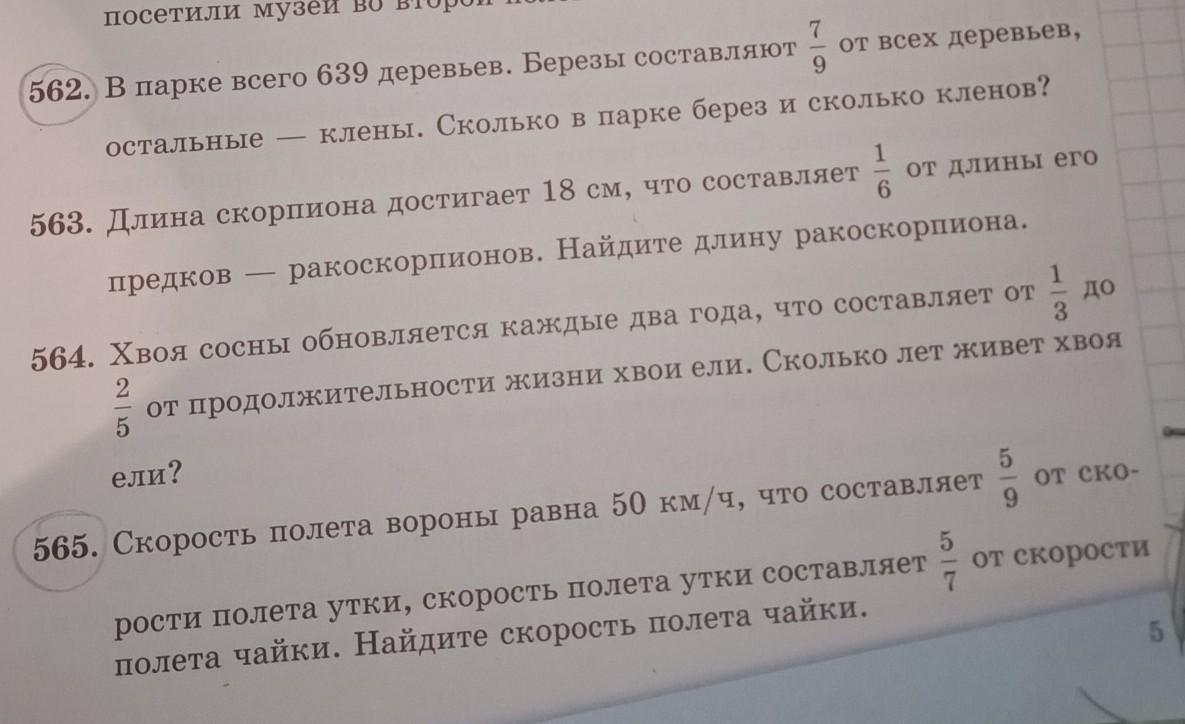
помогите пожалуйста надо сделать 562 565 с подробным решением! пожалуйста​

Приложения:

Ответы

Автор ответа: shaimardanovag
1

Ответ:

497 берёз

142 клена

утка 90 км/ч

чайка 126 км/ч

Пошаговое объяснение:

562 задание

639*7/9=497 берёз

639-497=142 кленов

565 задание

50:5/9=90км/ч утка

90:5/7=126 км/ч чайка


sultanovakarina58: напиши условия пожалуйста
sultanovakarina58: спасибо
Автор ответа: efimkorolev03
1

Ответ:

562.) 497 берёз, 142 клёна

565.) 126 км/ч

Пошаговое объяснение:

562.)

Если берёз 7/9 от количества всех деревьев, то надо умножить дробь на общее количество деревьев, чтобы получить количество берёз:

639*\frac{7}{9} = 497 берёз

Количество клёнов — это то, что будет, если из общего количества вычесть количество берёз, т.е. 639 - 497 = 142 клёна

565.)

Скорость вороны — 5/9 от скорости утки, то есть, 5 частей из девяти. То есть, скорость утки — это девять частей, а скорость вороны — пять частей. Найдём, чему равна одна частичка:

Т.к. скорость вороны — это пять частей,то 50 км/ч делим на 5:

\frac{50}{5}км/ч = 10 км/ч

А чтобы получить скорость утки, умножаем эту частичку на 9:

10*9 км/ч = 90 км/ч

Аналогично с чайкой и уткой:

Ищем одну частичку:

\frac{90}{5} км/ч = 18 км/ч

Потом ищем скорость чайки, у которой 7 частей:

18*7 км/ч = 126 км/ч


sultanovakarina58: спасибо большое
sultanovakarina58: напиши условия пожалуйста
Похожие вопросы
Предмет: Английский язык, автор: provot93
Помогите с переводом небольшого текста! Сложноват и не могу увязать

Railroads have experimented with other types of motive power. In the 1950s gas-turbine instead of diesel propulsion was tried for a few locomotives in the United States and Britain, but the results did not justify continuing development. There was a longer but very limited career in rail use for the compact and lightweight gas turbines developed for helicopters that became available in the 1960s. Their power-to-weight ratio, superior to that of contemporary diesel engines, made them preferable for lightweight, high-speed train-sets. They were applied to Canadian-built train-sets placed in service in 1968 between Montreal and Toronto and in 1969 between New York City and Boston, but these were short-lived because so much other unproved innovation in their design and equipment gave trouble. Most of a series of self-contained turbine-powered intercity train-sets acquired by French National Railways—and of copies operated by Egyptian Railways and by Amtrak in the United States—were still running in 1990. Some German diesel-hydraulic locomotives were fitted with a gas turbine to give them added short-period power, but the turbines were abandoned in 1981. By then the appeal of the turbine had evaporated through the sharp rise in price of its cruder category of oil fuel.
Several attempts were made to adapt the steam turbine to railroad traction. One of the first such experiments was a Swedish locomotive built in 1921. Other prototypes followed in Europe and the United States. They all functioned, but they made their appearance too late to compete against the diesel and electrification.
Предмет: Математика, автор: tokatulegenova
Предмет: Физика, автор: ekaterina200102