Предмет: Английский язык,
автор: ykaa
Помогите плизз номер 15,составить предложения и перевести.
Приложения:
Ответы
Автор ответа:
8
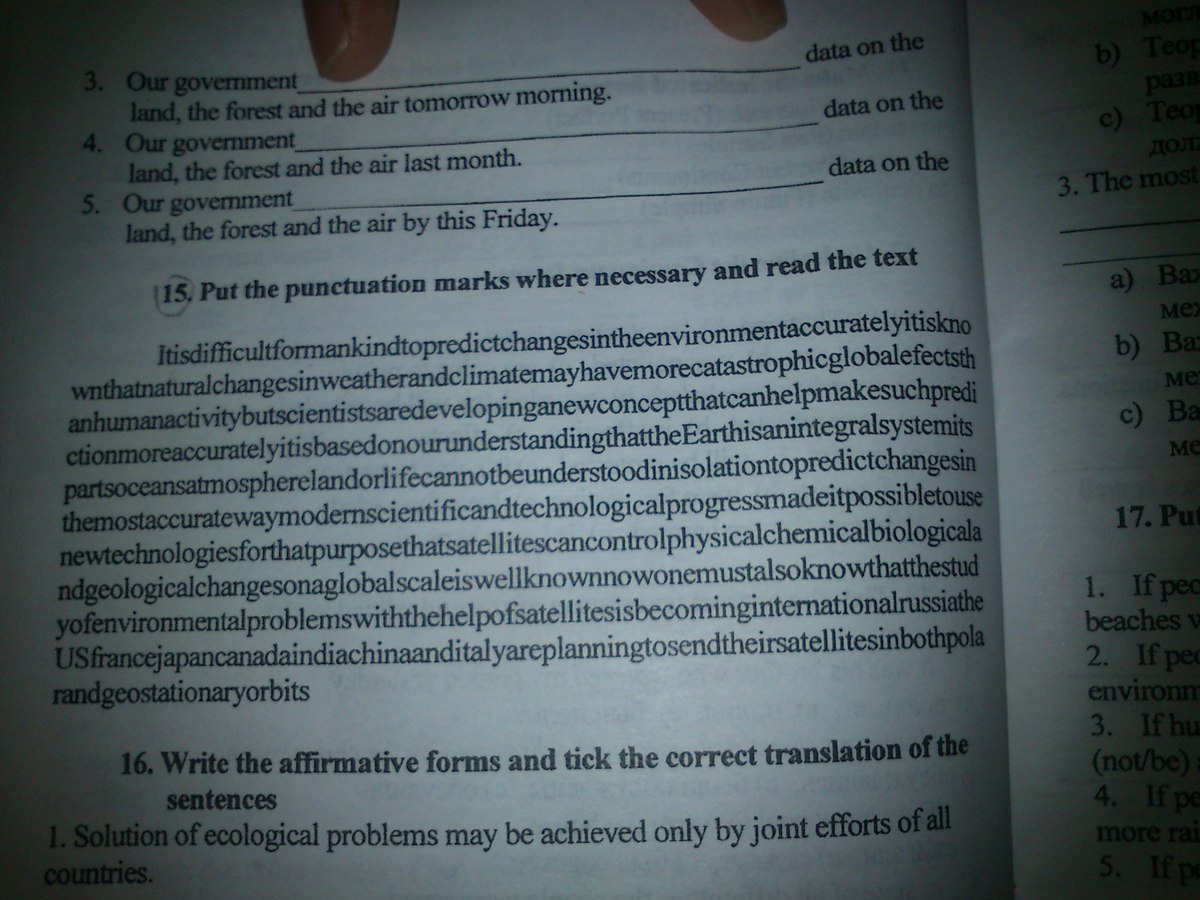
It is difficult for mankind to predict changes in the environment accurately. It is known that natural changes in weather and climate may have more catastrophic global effects than human activity, but scientists are developing a new concept that can help make such prediction more accurately. It is based on our understanding that the Earth is an integral system. Its parts - ocean, atmosphere, land or life cannot be understood in isolation. To predict changes in the most accurate way, modern scientific and technological progress made it possible to use new technologies for that purpose. That satellites can control physical, chemical, biological and geological changes on a global scale, is well known now. One must also know that the study of
environmental problems with the help of satellites is becoming international. Russia, the US, France, Japan, Canada, India, China and Italy are planning to send their satellites in both polar and geostationary orbits.
Людям трудно точно предсказать изминения в окружающей среде. Известно, что естественные изменения погоды и климата могут иметь еще более катастрофические глобальные последствия, чем деятельность человека, но ученые разрабатывают новую концепцию, которая поможет сделать такой прогноз более точным. Она основана на понимании, что Земля - это целостная система. Его части - океан, атмосфера, земля или жизнь - не могут быть поняты в отрыве друг от друга. Для прогнозирования изменений наиболее точным образом современный научно-технический прогресс сделал возможным использование новых технологий для этой цели.
То, что спутники могут контролировать физические, химические, биологические и геологические изменения в глобальном масштабе, хорошо известно в настоящее время. Следует знать и то, что изучение проблем окружающей среды с помощью спутников становится международным. Россия, США, Франция, Япония, Канада, Индия, Китай и Италия планируют направить свои спутники и на полярную, и на геостационарную орбиты.
environmental problems with the help of satellites is becoming international. Russia, the US, France, Japan, Canada, India, China and Italy are planning to send their satellites in both polar and geostationary orbits.
Людям трудно точно предсказать изминения в окружающей среде. Известно, что естественные изменения погоды и климата могут иметь еще более катастрофические глобальные последствия, чем деятельность человека, но ученые разрабатывают новую концепцию, которая поможет сделать такой прогноз более точным. Она основана на понимании, что Земля - это целостная система. Его части - океан, атмосфера, земля или жизнь - не могут быть поняты в отрыве друг от друга. Для прогнозирования изменений наиболее точным образом современный научно-технический прогресс сделал возможным использование новых технологий для этой цели.
То, что спутники могут контролировать физические, химические, биологические и геологические изменения в глобальном масштабе, хорошо известно в настоящее время. Следует знать и то, что изучение проблем окружающей среды с помощью спутников становится международным. Россия, США, Франция, Япония, Канада, Индия, Китай и Италия планируют направить свои спутники и на полярную, и на геостационарную орбиты.
Автор ответа:
1
It is difficult for mankind to predict changes in the environment
accurately. It is known that natural changes in weather and climate may
have more catastrophic global effects than human activity, but
scientists are developing a new concept that can help make such
prediction more accurately. It is based on our understanding that the
Earth is an integral system. Its parts - ocean, atmosphere, land or life
cannot be understood in isolation. To predict changes in the most
accurate way, modern scientific and technological progress made it
possible to use new technologies for that purpose. That satellites can
control physical, chemical, biological and geological changes on a
global scale, is well known now. One must also know that the study of
environmental problems with the help of satellites is becoming international. Russia, the US, France, Japan, Canada, India, China and Italy are planning to send their satellites in both polar and geostationary orbits.
Людям трудно точно предсказать изменения в окружающей среде. Известно, что естественные изменения погоды и климата могут иметь еще более катастрофические глобальные последствия, чем деятельность человека, но ученые разрабатывают новые концепции, которые помогут сделать такой прогноз более точным. Она основана на понимании, что Земля - это целостная система. Части Земли - океаны, атмосферу, землю или жизнь нельзя понять по отдельности. Для прогнозирования изменений наиболее точным способом, для этой цели современный научно-технический прогресс сделал возможным использование новых технологий. Спутники могут контролировать физические, химические, биологические и геологические изменения в глобальном масштабе, хорошо известные в настоящее время. Следует знать и то, что изучение
проблемы окружающей среды с помощью спутников становится международной. Россия, США, Франция, Япония, Канада, Индия, Китай и Италия планируют направить свои спутники на обеих полярных и геостационарных орбитах.
environmental problems with the help of satellites is becoming international. Russia, the US, France, Japan, Canada, India, China and Italy are planning to send their satellites in both polar and geostationary orbits.
Людям трудно точно предсказать изменения в окружающей среде. Известно, что естественные изменения погоды и климата могут иметь еще более катастрофические глобальные последствия, чем деятельность человека, но ученые разрабатывают новые концепции, которые помогут сделать такой прогноз более точным. Она основана на понимании, что Земля - это целостная система. Части Земли - океаны, атмосферу, землю или жизнь нельзя понять по отдельности. Для прогнозирования изменений наиболее точным способом, для этой цели современный научно-технический прогресс сделал возможным использование новых технологий. Спутники могут контролировать физические, химические, биологические и геологические изменения в глобальном масштабе, хорошо известные в настоящее время. Следует знать и то, что изучение
проблемы окружающей среды с помощью спутников становится международной. Россия, США, Франция, Япония, Канада, Индия, Китай и Италия планируют направить свои спутники на обеих полярных и геостационарных орбитах.
Похожие вопросы
Предмет: Английский язык,
автор: Helperno
Предмет: Русский язык,
автор: Kristi215
Предмет: Русский язык,
автор: омар40
Предмет: Русский язык,
автор: segenin15
Предмет: Математика,
автор: sofi6014