Предмет: География, автор: mudildo

Пожалуйста помогите с тестом по географии 6 класс,вулканы
Приложения:

Ответы

Автор ответа: kabylbekovasabina06
2

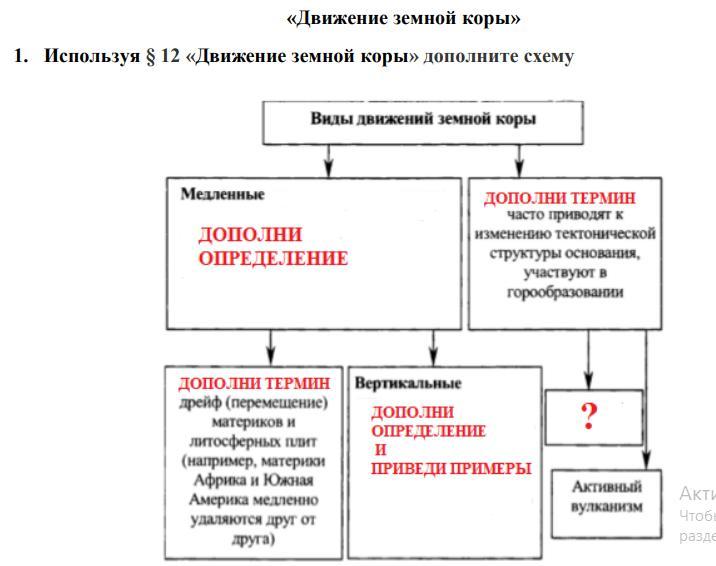
Медленные: этими движениями созданы разнообразные геологические структуры, образованы главнейшие неровности земной поверхности. Возвышенности, горы несут следы создавших их медленных поднятий, крупные низменности, впадины — результат постепенных опусканий, развивавшихся в течение геологического времени.

Дополнительный термин 1: Метки, устанавливаемые на берегах морей, позволяют определять скорость поднятия или погружения суши. Оказалось, что Скандинавия поднимается неравномерно — в средней части быстрее, на окраинах медленнее. Таким образом, поверхность здесь выгибается в виде обширного свода или купола. Наибольшая скорость поднятия (до 1 см в год) наблюдается на берегу Ботнического залива. Скорость опускания Голландии несколько больше.

Дополнительный термин 2:

Вегенер утверждал, что сначала на поверхности Земли возник тонкий слой гранитных пород. Со временем гранитные глыбы сконцентрировались в один большой праконтинент — Пангею, что произошло около 570—280 млн лет назад. Тогда же образовался праокеан, который окружал эту сушу. Затем Пангея раскололась и продолжала распадаться на более мелкие части. Эта революционная для тех лет теория достаточно просто объясняла многие непонятные геологические факты.

Вертикальные:

когда земная кора вспучивается, то в хрупких или сильно деформированных слоях пород происходит разлом. Если 2 разлома находятся близко друг к другу, участок коры между ними может быть вытолкнут вверх, либо провалиться ниже окружающих пород.

Похожие вопросы
Предмет: Английский язык, автор: vallgallrus

Read and translate the text. 


DIFFERENT TYPES OF TELEPHONE SYSTEMS. 

The word telephone comes from the Greek words tele, meaning “far,” and phone, meaning "sound," and refers to a telecommunications device that allows the human voice to travel across great distances. There are different types of telephones and corresponding types of telephone systems. The three main types of telephone systems are Plain Old Telephone Service, cellular wireless phones, and Internet
Protocol phones.
Landline telephone systems are part of the Plain Old Telephone Service (POTS), the analog service with copper wiring that is the direct great-grand-baby of the original telephone system courtesy of Alexander Graham Bell. The advantages include standardized equipment, predictable sound quality, and — due to direct connections to the central office of the company — no need to share the system’s capacity with
others. Because switches are in place, creating a private circuit for each phone call, it is also called the Public Switched Telephone Network (PSTN). A new-fangled term, given the recent alternatives, is “landlines.”
Another of the types of telephone systems is for cellular wireless phones, with individual companies having their own networks with varying technology. Like POTS systems, cellular wireless telephone systems are full-duplex systems, meaning that both people on the call can talk at the same time, but cell phones use radio frequencies, rather than copper wire. Though cellular networks began as mobile voice networks only, they now carry both voice and data. Some networks are national,
while others are international, and new technologies are continually in development. The networks known as 3G support not only cell phones, but also netbook computers, smartphones, and wireless modem aircards.
Internet Protocol (IP) telephone systems, also called Voice over Internet Protocol (VoIP), are another group of the telephone systems that are in use in the 21st century. This type of telephone service piggy-backs on existing Internet service, either cable service or DSL broadband. A device called an Analog Telephone Adaptor is the go between that connects whatever phone you happen to have with either your broadband modem – or your router, if you have one.
IP systems can be set up with a single line for both Internet and telephone service, which can save money.
With an Integrated T1 line, instead of being set up for voice, on the one hand, or data, on the other, the T1 line is able to handle both. With Dynamic T1, the line is capable of assigning bandwidth as needed, given the current use.

Предмет: Математика, автор: SemEdinorog